
Home›Blog›Coaching by Evidence, Not by Gut
Coaching by Evidence, Not by Gut
By Vladimir Simeonov

Coaching is the highest-leverage thing a sales manager does. It is also the part most often aimed by instinct — at the wrong people, and the wrong problems.
Ask an experienced commercial leader what actually develops a sales team and the answer is rarely the incentive plan or the annual training course. It is coaching — the ongoing, individual work of helping each representative get better at the specific things they are not yet good at. It is the highest-leverage thing a sales manager does.
It is also, in most organisations, the part most often run on instinct. The question is not whether managers should coach; they should, and they do. The question is whether that coaching reaches the right people and addresses the right problems. More often than it should, it does not — and not because the managers are poor coaches, but because they are coaching with bad inputs.
How coaching attention actually gets allocated
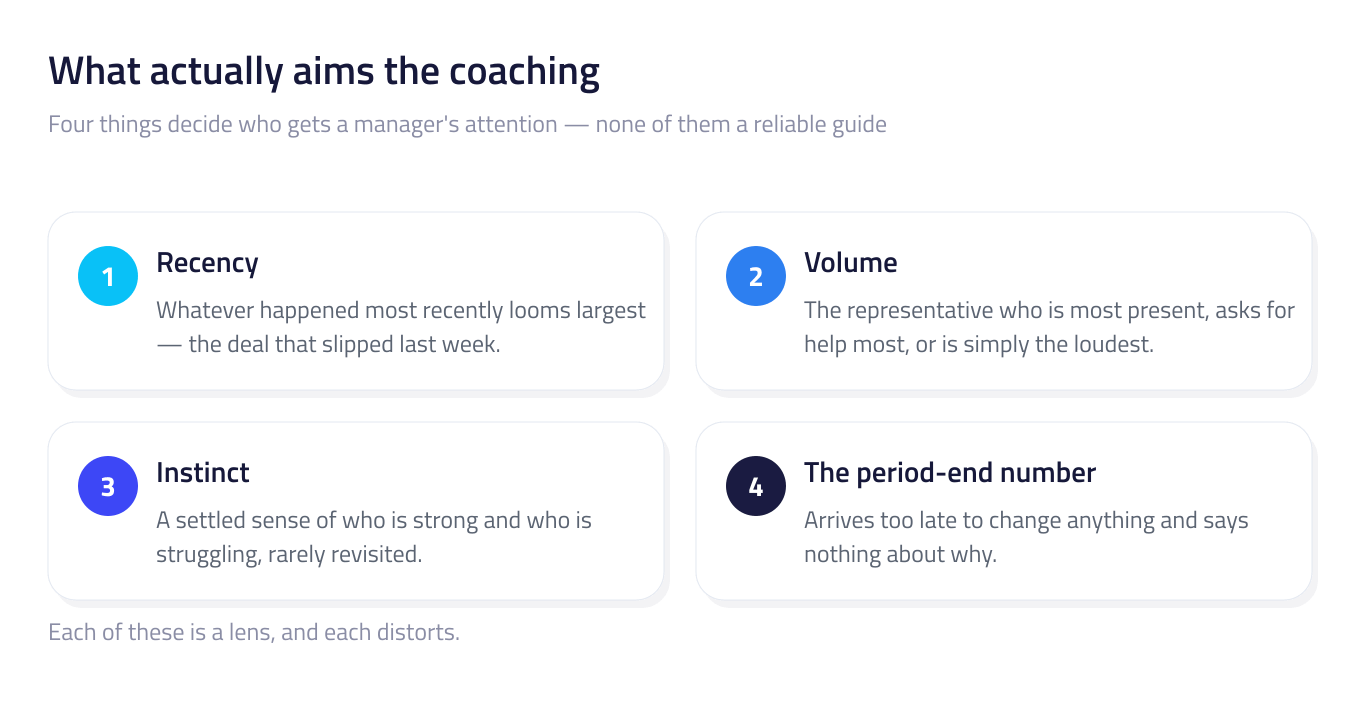
A manager has limited time and a dozen or more representatives. Something has to decide who gets the attention and on what. In practice, four things do, and none of them is a reliable guide.
Recency: whatever happened most recently looms largest — the deal that slipped last week, the complaint that arrived yesterday. Volume: the representative who is most present, who asks for help most, or who is simply the loudest, takes a disproportionate share. Instinct: the manager's own settled sense of who is strong and who is struggling, formed over time and rarely revisited. And the period-end number, which arrives too late to change anything and, worse, says nothing about why.
Each of these is a lens, and each distorts. Together they aim coaching at the visible and the recent rather than at the people and problems that most need it.
The gut is working with bad inputs
This is less a failure of judgement than a shortage of information. A manager cannot be in twelve territories at once. They see fragments: the occasional ride-along, a handful of calls, the numbers at period-end.
A ride-along is a sample of one, on a day the representative knew they were being watched — close to the least representative data available. Memory fills the gaps, and memory leans toward the recent and the dramatic. And in the absence of evidence, confidence gets mistaken for competence: the representative who speaks well in the team meeting is assumed to be performing well in the field, and the quiet one is assumed to be fine. None of these inputs is trustworthy, and a careful manager reasoning well from untrustworthy inputs still reaches untrustworthy conclusions.
The two representatives who get coached wrong
Two patterns recur, and between them they account for a great deal of misdirected coaching.
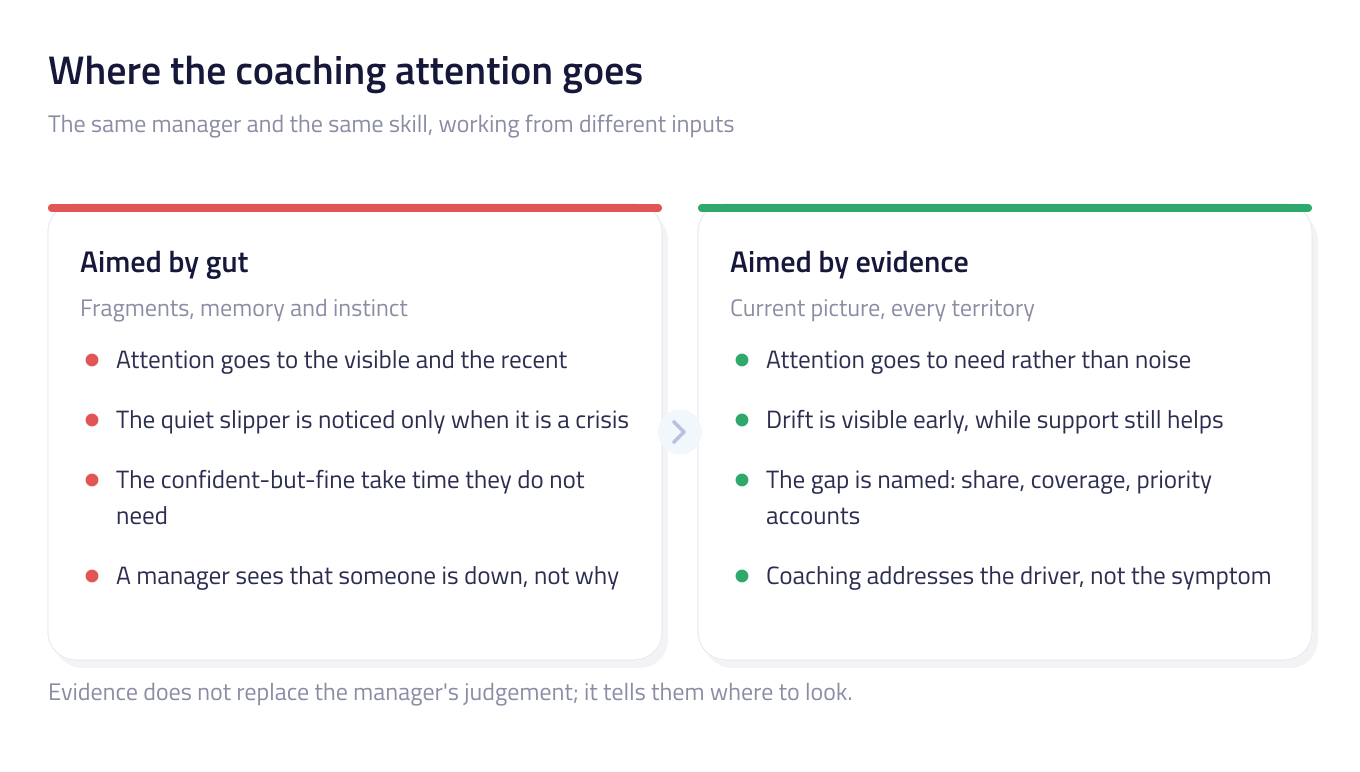
The first is the quiet slipper: a steady, undramatic representative whose performance is gradually drifting in a way nobody notices, because they don't ask for help and nothing about them sets off an alarm. They get no attention until the slide becomes a crisis — a badly missed quarter, or a resignation — at which point the coaching that might have helped six months earlier arrives too late to be coaching at all.
The second is the confident-but-fine representative: capable, vocal, comfortable asking for support, and therefore the recipient of a steady stream of a manager's time they don't especially need. The attention feels productive — there are conversations, there is engagement — but it is being spent where the marginal return is lowest. Between these two, a manager can be working genuinely hard at coaching and still be aiming most of it in the wrong direction.
What changes with evidence
Evidence does not mean replacing the manager's judgement with a score. It means giving them a current, consolidated picture of what is actually happening across every territory, so the decision about where to look rests on what is true rather than on what is visible.
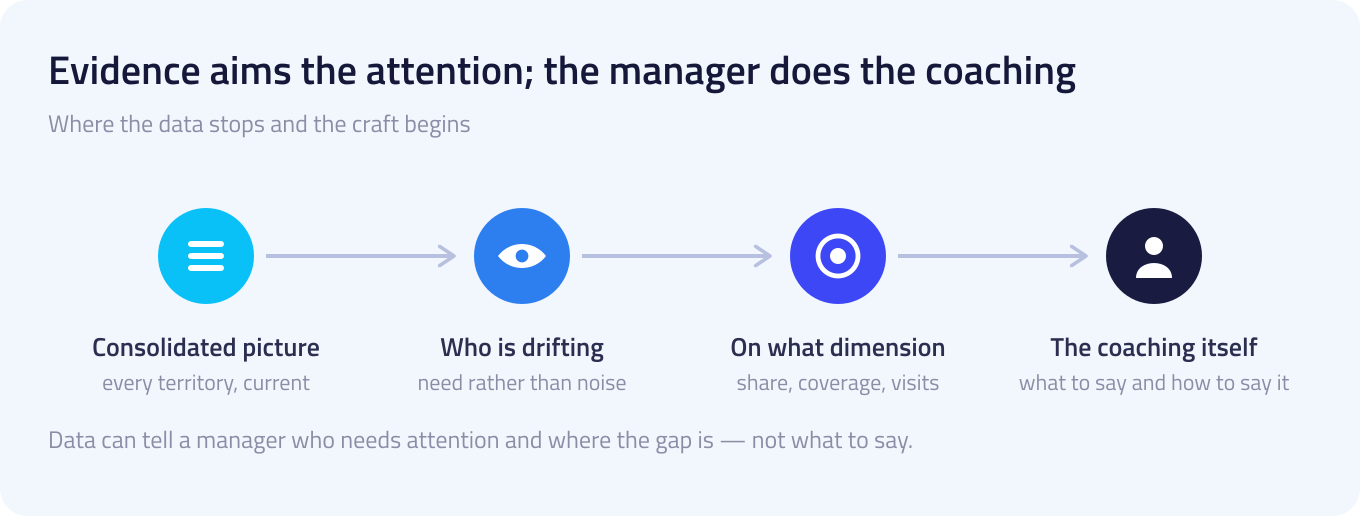
With that picture, a manager can see who is genuinely drifting and — crucially — on what dimension. Not merely that a representative is down, but that their market share is slipping in one specific chain, or that their visits are not matching the priority accounts, or that a high-potential territory is being under-covered. Attention goes to need rather than noise. And because the picture shows where the gap is, the coaching can address the actual driver instead of the symptom the manager happened to notice.
Evidence makes coaching fair — and fairness keeps people
There is a second effect that matters as much as accuracy. Evidence lets a manager tell a coachable execution gap apart from a hard territory or plain bad luck. A representative working a genuinely difficult patch should not be coached as though they are underperforming; one who is coasting in an easy territory should not be left alone because the numbers still look acceptable. Without data, those two can look identical — and the representative on the receiving end always knows when a judgement is unfair.
That fairness shows up in retention. Specific, evidence-based feedback lands in a way a hunch never does. "You are not covering these high-potential accounts" is something a representative can act on and respect; "I feel like you are not pushing hard enough" invites defensiveness and resentment. And the quiet slipper — the representative most likely to disengage and eventually leave — gets noticed and supported early, while support still helps. People tend to stay where they are coached fairly, specifically, and in time.
Evidence tells you where to look — not what to say
It is worth being clear about the limit, because this is where the human stays essential. Data can tell a manager who needs attention and where the gap is. It cannot tell them what to say, how to say it, or how to build the trust that makes a representative willing to hear it.
Coaching is still a craft — reading the person, choosing the moment, framing the message so it develops rather than deflates. Evidence aims the attention; the manager does the coaching. Used the other way around, as a score to wave at people, it does more harm than instinct ever did. The point is not to make coaching mechanical. It is to stop it being misdirected.
Conclusion
Coaching is too valuable to leave aimed by accident. A manager running on recency, volume, and gut feel is not a bad coach; they are a good coach pointed in the wrong direction by poor information. Give them an accurate picture of what is actually happening across their team and the same coaching skill suddenly lands where it counts — on the people who need it, the problems that are real, and early enough to matter.
This is what consolidated execution data makes possible for a sales manager. Pharmalyze.AI brings performance across every territory into one current view — who is drifting, on what dimension, and where — so coaching attention can be allocated by evidence rather than by whoever was loudest or most recent. It does not coach anyone; that remains the manager's craft. It simply helps ensure the craft is aimed at the right people, the real problems, and in time to help.