
Home›Blog›Data Governance as a Commercial Advantage
Data Governance as a Commercial Advantage
By Vladimir Simeonov
In enterprise pharma, the way a tool handles data often decides whether it gets bought. Treating governance as a constraint to minimise misses that it is also the fastest route to yes.
Inside most pharma organisations, data governance is experienced as friction. It is the set of constraints the security and IT teams impose, the gauntlet every new tool has to run before anyone is allowed to use it. Framed that way, governance is a tax — a cost you pay to stay compliant, quietly deducted from the pace of everything else.
That framing is incomplete, and for anyone selling technology into pharma — or for the pharma company deciding whether to adopt it — getting it wrong is expensive. Handled well, governance is not a cost at all. It is one of the most direct routes to getting something deployed in the first place.
The tax, as it is usually experienced
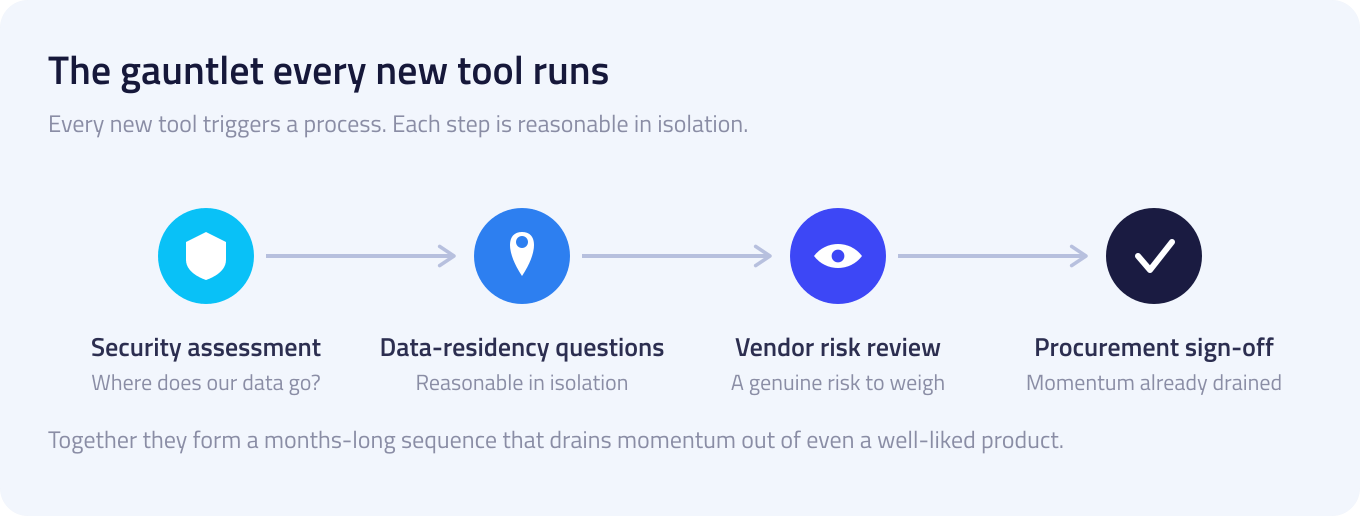
Every new tool triggers a process: a security assessment, data-residency questions, vendor risk review, procurement sign-off. Each step is reasonable in isolation. Together they form a months-long sequence that drains momentum out of even a well-liked product.
For AI tools the friction is sharpest, because the first question is also the hardest. Where does our data go, and what happens to it once it is there? Security teams have learned that the honest answer is often uncomfortable, so the safe institutional response becomes "no," or "not yet" — which, at the speed business actually moves, amounts to the same thing. The capability of the tool barely gets discussed. The conversation stalls at the data question and never reaches the value.
Why the instinct to say no is rational
It would be easy to read this as obstruction. It is not. Pharma operates under strict IT, compliance, and security expectations, and for good reason. Even commercial data that is not patient data — sales figures, territory structures, account relationships, pricing dynamics — is genuinely sensitive and competitively valuable. It is the kind of information a company has every reason to guard closely.
So a security team that defaults to caution is doing its job in an environment where the downside of a mistake is large and hard to reverse. The friction is not irrational. The real problem is that most tools give the security team no good way to say yes quickly — they present a genuine risk to weigh, and weighing it properly takes time.
The question that decides the deal
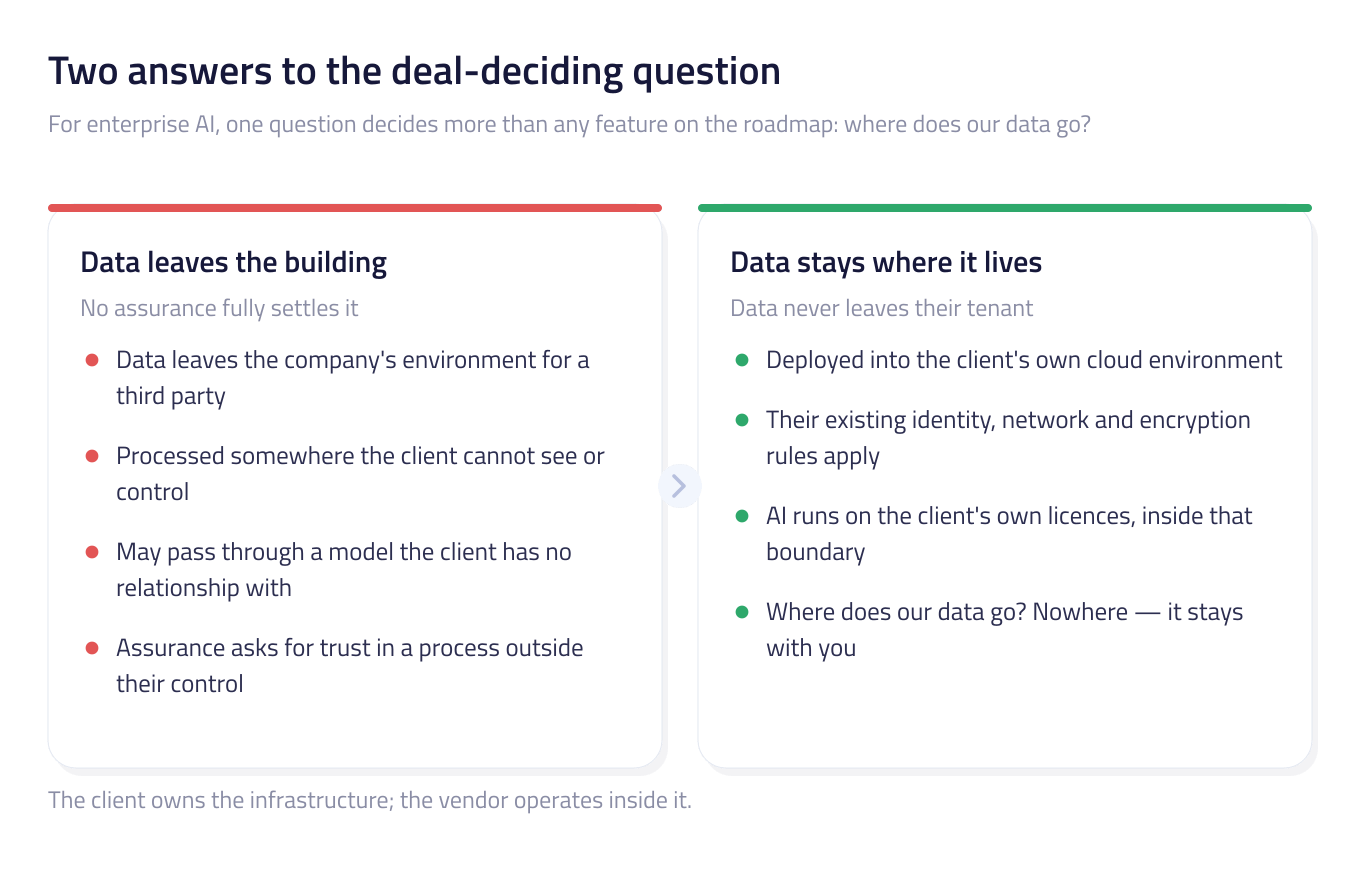
For enterprise AI specifically, one question decides more than any feature on the roadmap: where does our data go? Most AI tools answer it badly, often without meaning to.
The data leaves the company's environment. It flows to a third-party service. It is processed somewhere the client cannot see or control. It may pass through a model the client has no direct relationship with and no visibility into. Each of those is, on its own, a reason for a security team to pause — and a pharma security team will find every one of them. When the architecture requires data to leave the building, no amount of assurance fully settles the matter, because the assurance is asking the client to trust a process happening outside their control.
The architectural answer: keep the data where it already lives
There is a fundamentally different design, and it changes the conversation. Do not move the data out at all.
Deploy the software into the client's own cloud environment, so their data never leaves their tenant. Their existing security policies, identity controls, network rules, and encryption apply unchanged — not as a special arrangement, but because the software is simply running inside the boundary they already manage. Where AI is involved, it runs on the client's own AI licences, within that same boundary. The client owns the infrastructure; the vendor operates inside it.
This is not a concession extracted in a tough negotiation. It is the architecture, chosen deliberately, because it answers the deal-deciding question before it is even asked. "Where does our data go?" becomes "nowhere — it stays with you." There is very little left to negotiate after that.
Why this is a commercial advantage, not just an IT nicety
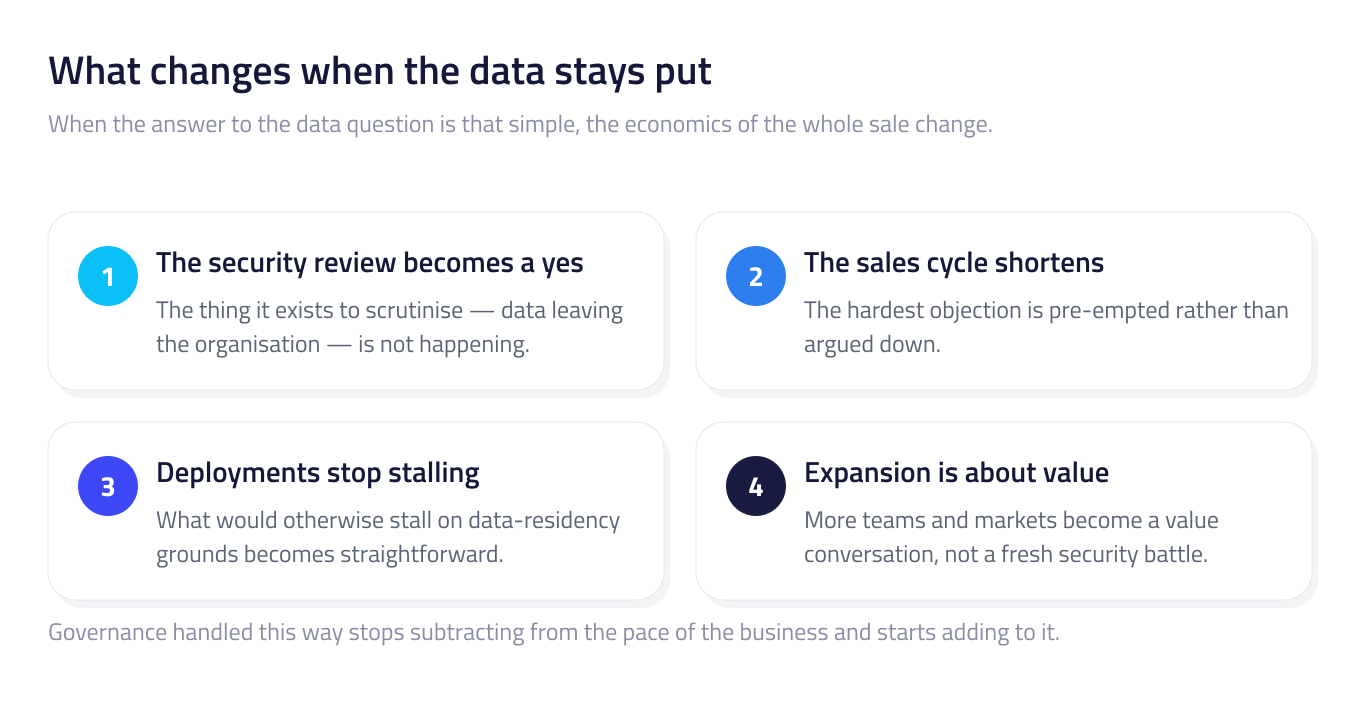
When the answer to the data question is that simple, the economics of the whole sale change.
The security review stops being an obstacle and becomes a fast yes, because the thing it exists to scrutinise — data leaving the organisation — is not happening. The sales cycle shortens, because the hardest objection has been pre-empted rather than argued down. Deployments that would otherwise stall indefinitely on data-residency grounds become straightforward. And trust, once it is established on the data question, is what turns expansion — more teams, more markets — into a conversation about value rather than a fresh security battle every time.
Governance handled this way stops subtracting from the pace of the business and starts adding to it. It is the thing that unlocks the deal, not the thing that delays it. For the vendor, it is a competitive advantage; for the pharma company, it is what lets them adopt useful technology without betting control of their data on it.
You design governance in — you cannot bolt it on
There is a deeper point underneath all of this, and it is the reason governance cannot simply be promised. It has to be built in from the start.
Governance retrofitted onto a tool that was designed to pull data out is never fully convincing, because a competent security team can see the architecture underneath the reassurances. The documentation says one thing; the data flows say another. A tool designed from the beginning to keep data inside the client's environment does not have to argue that it is safe — the structure makes the argument on its behalf. That is why governance is an architectural decision rather than a documentation exercise, and why it only pays commercial dividends when it is a foundation rather than a coat of paint applied late to pass a review.
Conclusion
Treating data governance as a compliance tax gets the economics backwards. In enterprise pharma, the way a tool handles data is not the price of doing business — it is frequently the single factor that decides whether the business gets done at all. The companies and vendors that understand this stop trying to minimise governance and start treating it as a feature: the one that converts a long, sceptical security review into a short yes.
Pharmalyze.AI is built on exactly this principle. It deploys into the client's own cloud environment, so commercial data stays within the client's boundary, under their existing security, identity, and encryption controls, with AI running on the client's own licences. It is developed around the security practices and certification frameworks enterprise pharma expects, and the governance is not a constraint added at the end to satisfy a checklist. It is the design — and it is part of what lets the platform be adopted, and then expanded, without the data question ever becoming the thing that stops it.