
Home›Blog›From Data-Rich to Decision-Ready
From Data-Rich to Decision-Ready
By Vladimir Simeonov
Pharmaceutical companies are not short of data. They are short of the daily, decision-ready insight that turns that data into action in the field.
Over the past decade, pharmaceutical companies have invested heavily in data. They have CRM systems tracking every visit, ERP systems running the supply chain, subscriptions to external market data, sell-in and sell-out feeds, warehouse and wholesaler reports, and internal BI dashboards built by analytics teams. By most measures, the commercial side of pharma is data-rich.
And yet, on a typical Tuesday morning, a sales representative preparing for a pharmacy visit still struggles to answer a simple question: what should I focus on today, and why? The information exists. It is just spread across systems, formats, and reporting cycles that were never designed to work together at the speed of a working day.
This is the gap that matters now. Not the gap between having data and not having it — most companies cleared that years ago — but the gap between having data and being able to act on it.
Section 1: Pharma does not have a data shortage — it has an actionability gap
The volume of commercial data inside a mid-to-large pharma organisation is substantial. Pharmacy-level sales, wholesaler movements, warehouse stock, CRM activity, ERP transactions, external market data, performance reports — each of these is a system in its own right, often owned by a different team and updated on a different schedule.
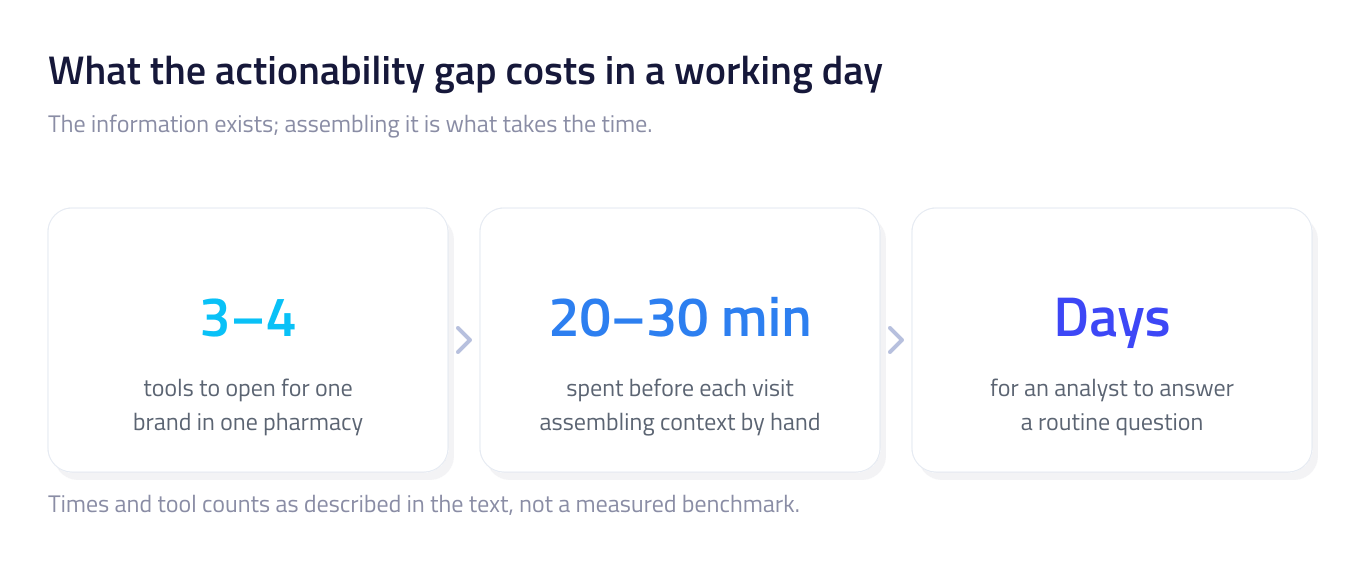
The problem is not collection. It is interpretation. A representative who wants to understand how a single brand is performing in one pharmacy may need to open three or four tools, reconcile numbers that don't quite match, and still end up making a judgement call. An analyst can answer the question, but that turns a routine decision into a request that takes days.
So the data sits in silos, technically available but practically out of reach for the people who need it most in the moment. The bottleneck is the translation step — from raw numbers to a clear answer — and that step is where most commercial value is currently lost.
Section 2: Why field teams need better daily insights
A field representative's day is a sequence of small decisions. Which accounts to prioritise this week. Which product to lead with in this pharmacy. What to raise with this account, given what changed since the last visit. None of these are strategic decisions in the boardroom sense, but together they determine commercial performance far more than any quarterly plan.
Without consolidated, ready-to-use insight, representatives fall back on two things: intuition and time. They rely on what they remember and what they sense, and they spend twenty to thirty minutes before each visit assembling context manually — checking one system for sales, another for the last visit note, a third for targets.
Consider a representative about to walk into a pharmacy. To be effective, they need to know how the brand is trending there, whether market share is above or below target, what was discussed last time, and what has changed since. That context already exists in the company's systems. The issue is that pulling it together takes longer than the visit itself, so it often doesn't happen — and the representative walks in underprepared.
Better daily insight is not a luxury here. It is the difference between a visit that advances an account and one that simply maintains contact.
Section 3: From fragmented data to commercial intelligence
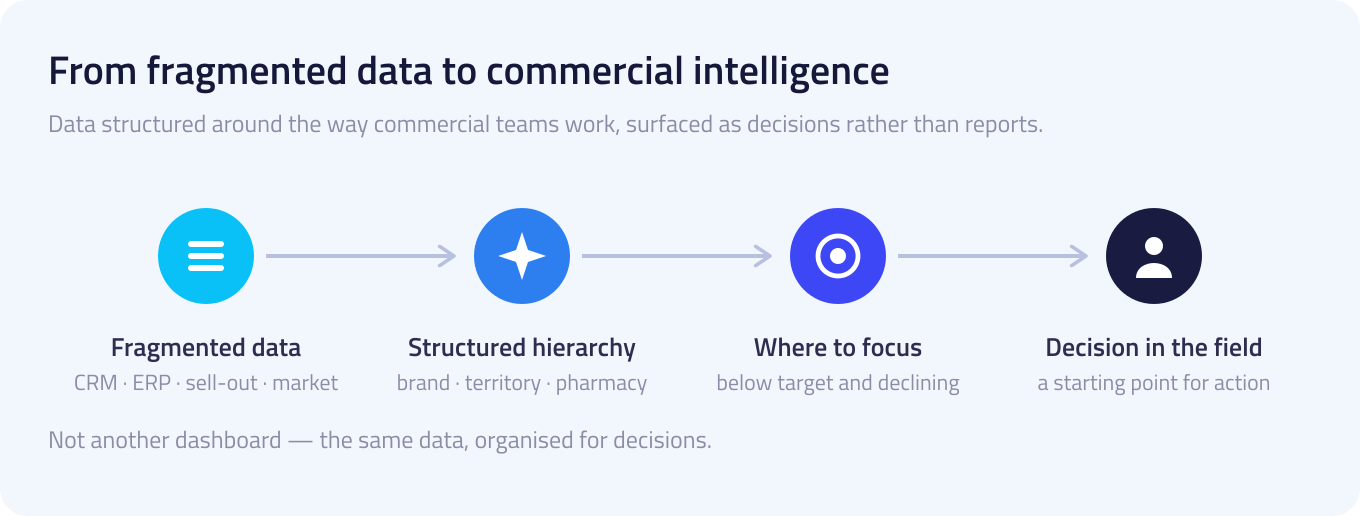
The answer is not another dashboard. Most commercial teams already have more dashboards than they use. The answer is commercial intelligence — data structured around the way commercial teams actually work, and surfaced as decisions rather than reports.
Pharma commercial work follows a natural hierarchy: brand, then brand within a territory or brick, then performance within the pharmacies in that territory, then the doctors and accounts behind it. Commercial intelligence organises data along that same path, so a user can start from a brand view and drill down to the specific pharmacy in front of them without changing tools or losing context.
The shift is from what happened to what to do about it. A traditional market-share report tells a representative their share dropped two points last quarter. A commercial intelligence layer tells them which three pharmacies in their territory are below target and declining, shows the numbers behind it, and points to where the recoverable potential sits. Same underlying data — but one is a record, and the other is a starting point for action.
Section 4: How Pharmalyze.AI supports sales and medical teams
This is the problem Pharmalyze.AI is built to address. It combines and structures fragmented commercial data so that sales and medical representatives can prepare for a visit in minutes rather than half an hour, from a single mobile-first screen.
In practice, that means a representative can see brand, territory, pharmacy, and product performance in one place, review what happened in previous visits, and capture notes by voice straight after a meeting. They can ask questions in plain language — where am I losing share, which pharmacies need attention this week, what changed since my last visit — and get answers grounded in their own company's data rather than generic guidance.
The platform also surfaces untapped potential: pharmacies, products, or territories where performance is below where it could be, and where focused effort is likely to pay off. The aim is straightforward — shorter preparation time, sharper targeting of visits, and more consistent execution across a field force, without asking representatives to become data analysts.
Section 5: The management perspective — visibility, execution, and performance
For managers, the actionability gap shows up differently. The challenge is not preparing for a single visit; it is seeing clearly across an entire team and territory. Many sales managers operate with limited, delayed visibility into how execution is actually going — which territories are on plan, where visit quality is slipping, which opportunities are being missed.
Commercial intelligence closes that gap for managers too. It makes it possible to monitor execution across regions, identify underperforming territories early, spot accounts with declining sales before they become losses, and direct coaching to where it will matter most. It also brings consistency: when every representative works from the same structured insight, performance depends less on who happens to be the most diligent at assembling their own data.
Perhaps most importantly, it strengthens the link between strategy and the field. A commercial plan set at headquarters only works if it reaches the pharmacy counter intact. Better visibility into execution is what keeps strategy and field reality aligned — and it does so by making the existing field force more effective, rather than simply adding headcount.
Section 6: The future of pharma sales is data-driven, but human-led
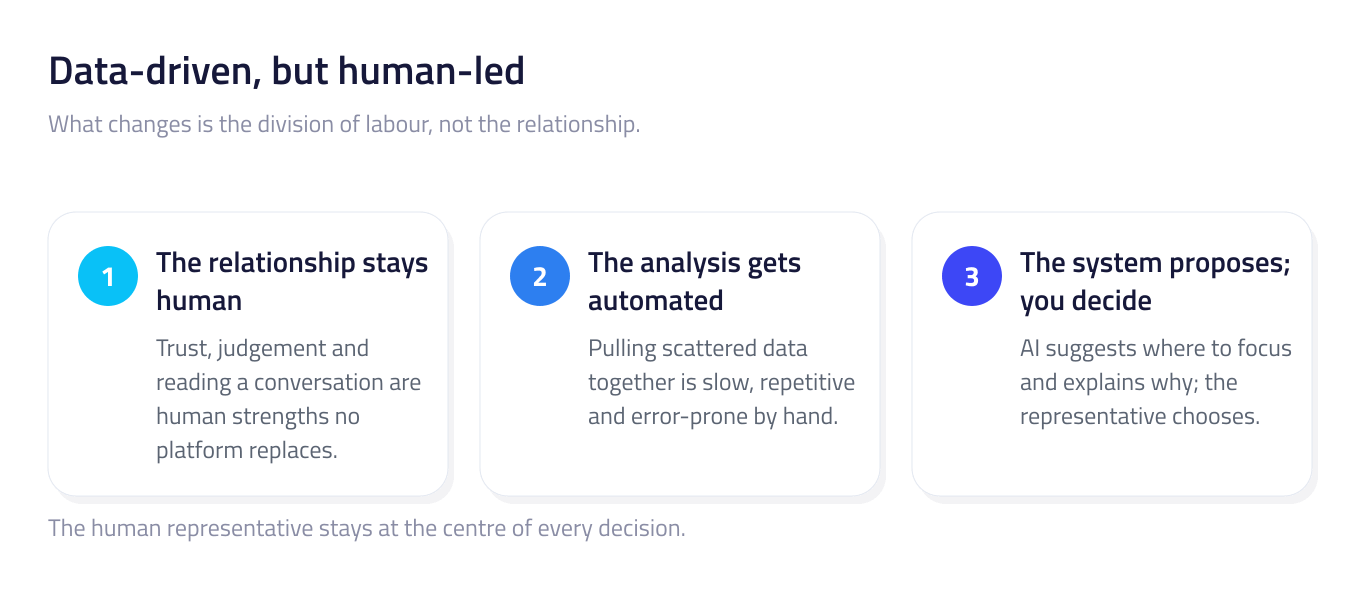
It is worth being clear about what this does and does not change. The representative's relationship with a pharmacist or a doctor remains the central commercial asset. Trust, judgement, and the ability to read a conversation are human strengths, and no platform replaces them.
What changes is the division of labour. The analysis — pulling together scattered data, spotting patterns, flagging risks and opportunities — is exactly the kind of work that should be automated, because it is slow, repetitive, and error-prone when done by hand. Freeing representatives from it gives them more time for the part of the job only they can do.
The right model is simple: the system proposes, the person decides. AI suggests where to focus and explains why; the representative weighs that against everything they know about the account and chooses. Data-driven, but human-led.
Conclusion
The pharmaceutical companies that pull ahead commercially over the next few years will not be the ones with the most data. Most already have more than they can use. They will be the ones who close the actionability gap — who make existing data usable in daily decisions, for the people in the field who act on it.
That is the practical promise of AI in commercial pharma: not to replace expertise, but to put the right information in front of the right person at the moment they need it, so they can make a better decision.
Pharmalyze.AI was built for exactly this. It is an AI-powered commercial intelligence platform that takes the fragmented data pharma companies already own and turns it into clear priorities, recommendations, and insight — helping sales and medical teams prepare faster, target better, and execute more consistently, while keeping the human representative firmly at the centre of every decision.