
Home›Blog›From What Happened to What Should I Do
From What Happened to What Should I Do
By Vladimir Simeonov

The most useful question in commercial analytics is also the one most tools never reach. Getting there has less to do with clever technology than with a willingness to turn a description into a decision — and to be honest about its limits.
There is a natural progression in how data becomes useful, and it can be described without a single piece of jargon. It runs through four questions, each building on the one before. Most commercial analytics answers the first one or two well and then stops — which is a problem, because the questions that actually change a representative's afternoon are the ones at the end.
Four questions, not four technologies
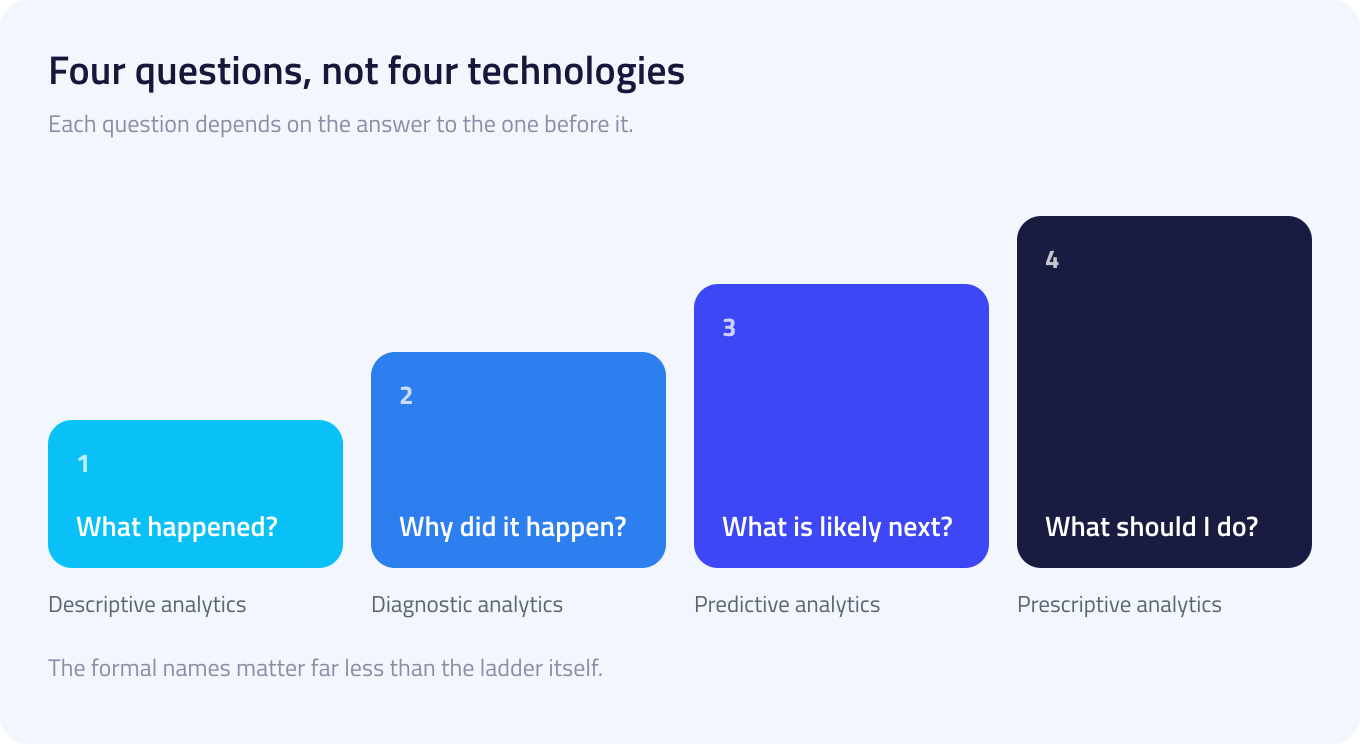
The ladder is simple.
What happened? Sales in a territory are down this quarter. Why did it happen? The decline is concentrated in two accounts, one of which a competitor has been gaining in. What is likely to happen next? At the current trend, share in that territory keeps slipping. What should I do about it? Prioritise those two accounts this week, lead with the product that is losing ground, and address the competitive switch directly.
Each question depends on the answer to the one before it. You cannot sensibly say what to do without first knowing why something happened and where it is heading. These four steps have formal names — descriptive, diagnostic, predictive, and prescriptive analytics — but the names matter far less than the ladder itself. The point is that "what should I do" sits at the top, and you have to climb to reach it.
Most pharma stops at the first rung
The overwhelming majority of commercial reporting answers only the first question. Dashboards, sales reports, period comparisons — all of them describe what happened, with great precision and very little guidance about what to make of it.
Some teams reach the second rung, "why," through manual analysis — an analyst digging into the drivers behind a number. Very few reach "what is likely" or "what should I do" in any systematic way. Those last two rungs get left to the individual to work out in their head, every time, under time pressure, just before a visit. Which means the most valuable steps on the ladder are precisely the ones that depend on a busy person's spare mental capacity — and spare capacity is the thing a field representative has least of.
What "what should I do" actually looks like
It helps to be concrete, because "prescriptive insight" sounds more exotic than it is. In practice it is not a dashboard and not a number. It is a short, specific, reasoned suggestion delivered at the point of action.
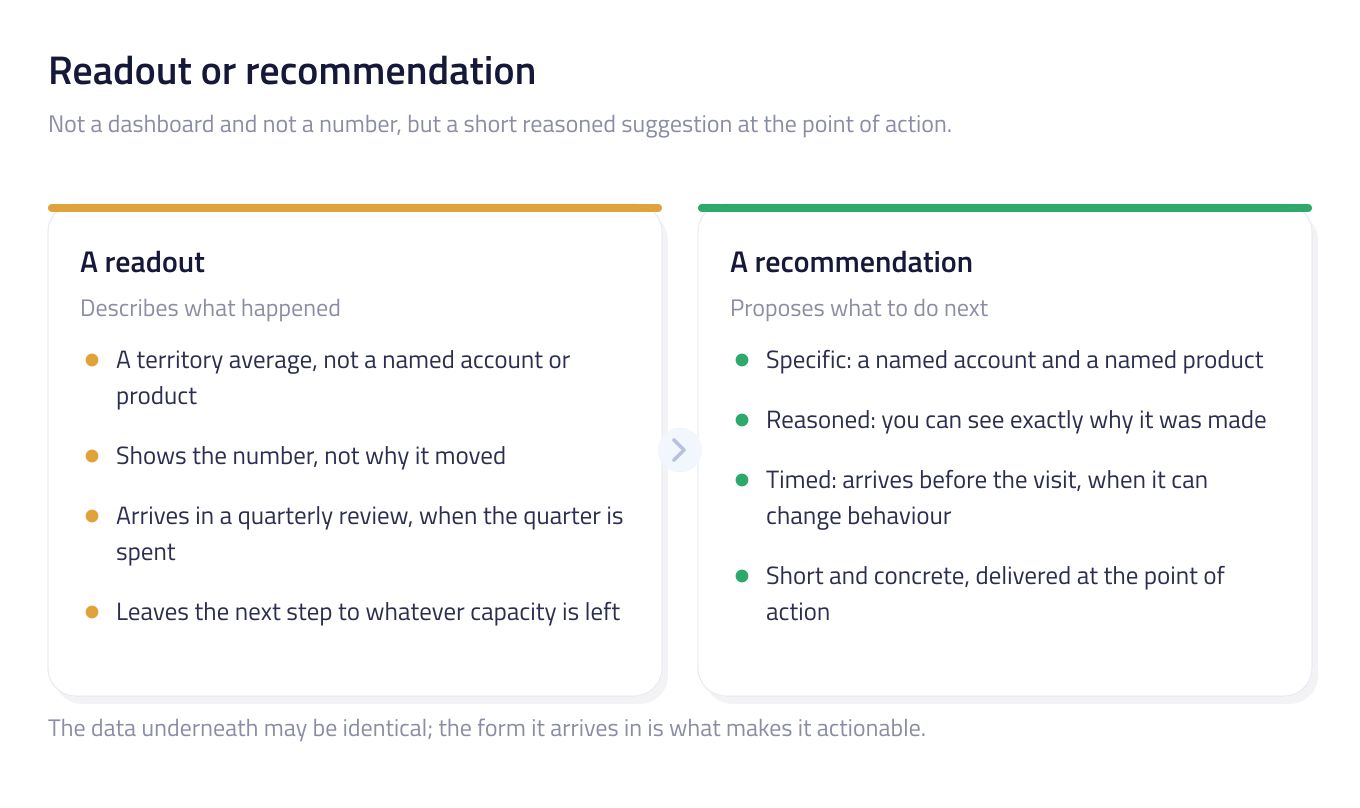
Something like: Of today's visits, this account is the one to prioritise. Its market share has dropped twelve per cent across two periods, the decline sits almost entirely in one product, and a competitor gained in the same window. Worth opening with that product.
Notice what makes that useful. It is specific — a named account, a named product, not a territory average. It is reasoned — you can see exactly why the recommendation was made, not just what it is. And it is timed — it arrives before the visit, when it can change behaviour, not in a quarterly review when the quarter is already spent. That is the difference between a readout and a recommendation. The data underneath may be identical to what a dashboard would show; the form it arrives in is what makes it actionable.
A recommendation is a starting point, not an order
This is where the limits matter, and where a lot of "AI for sales" goes wrong. A recommendation has to remain a suggestion. It cannot become an instruction.
The representative knows things the data does not. That the pharmacy in question is mid-renovation and not the right place to push this week. That the "declining" account is actually transferring stock between locations and the numbers are misleading. That a relationship needs a softer approach right now for reasons no system can see. A tool that issues orders is wrong the moment reality diverges from its data — and reality diverges constantly. A tool that offers a reasoned suggestion lets the human fold in everything the data missed.
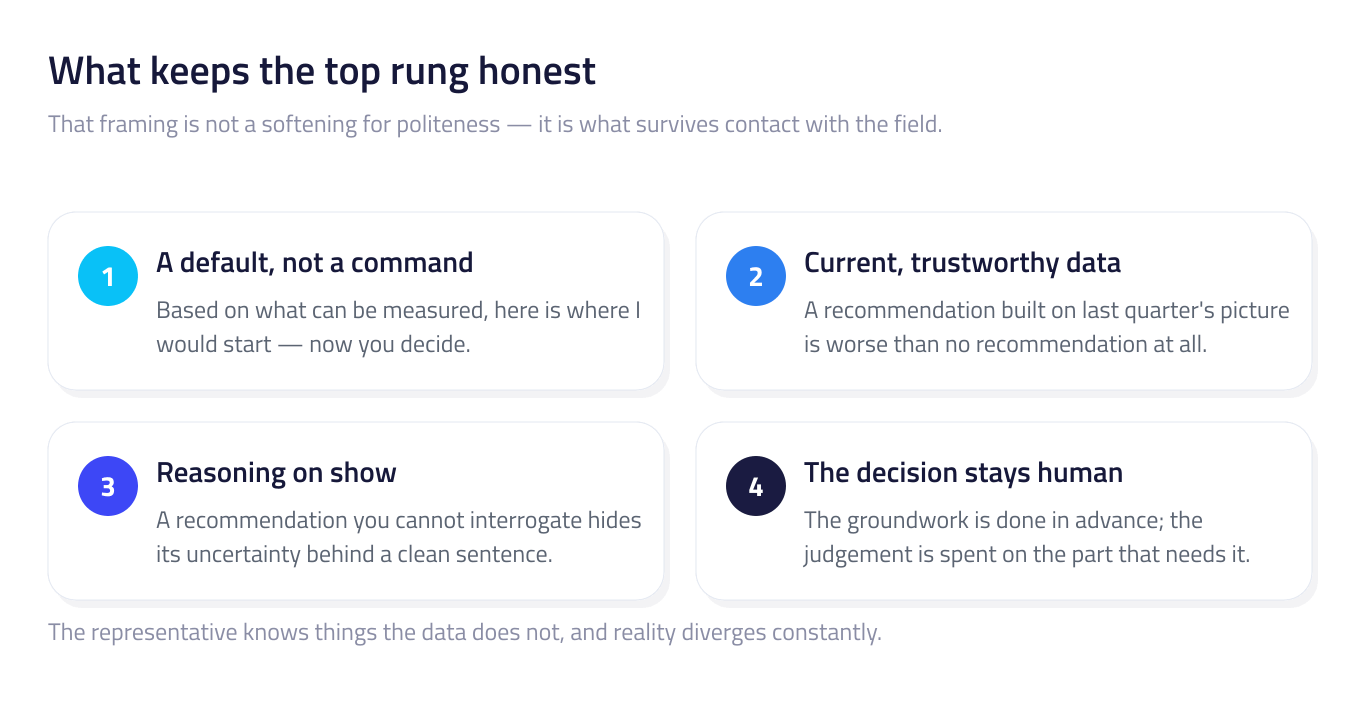
So the recommendation earns its place by being a good default, not a command. It says, in effect: based on what can be measured, here is where I would start — now you decide. That framing is not a softening for politeness. It is the only framing that survives contact with the field.
It is only as good as the data and the assumptions beneath it
The second limit is less comfortable to talk about but more important. A recommendation inherits every weakness of its inputs. Stale data produces confident, wrong advice — and confident wrong advice is more dangerous than an honest gap, because people act on it. A hidden assumption, such as treating last year as a reliable guide to this year, or assuming all accounts behave alike, quietly shapes the answer without ever announcing itself.
That makes two things non-negotiable. The data has to be current and trustworthy, because a recommendation built on last quarter's picture is worse than no recommendation at all. And the reasoning has to be visible, so the user can check it rather than take it on faith. A recommendation you cannot interrogate is worse than a plain number you can, because it hides its own uncertainty behind a clean, decisive sentence. The moment a representative can see why the system suggested something, they can judge whether the reasoning holds in their territory — and that judgement is exactly what keeps a good tool honest.
The goal is a faster, better-informed decision — still made by a person
Put the limits together and the purpose becomes clear. Climbing the ladder is not about automating the decision. It is about doing the slow, repetitive groundwork — assembling the data, diagnosing the cause, projecting the trend — so that the person arrives at the decision faster and better-informed than they could alone.
The decision itself stays human. What changes is how much solitary work the human had to do to reach it. Instead of starting from a blank screen and a stack of systems, they start from a specific, reasoned, checkable suggestion — and spend their judgement on the part that actually needs it.
Conclusion
The most valuable question in commercial analytics is the last one on the ladder, and it is the one most tools never climb to. Reaching it is less a matter of clever technology than of willingness — to turn a description into a specific, reasoned, well-timed suggestion, and to be honest that the suggestion is a default a person should overrule when they know better.
This is the rung Pharmalyze.AI is built to reach. It takes the same data that usually stops at "what happened" and carries it through to a clear recommendation for the account in front of the representative — specific, with its reasoning on show, and delivered when it can still change the visit. It does not make the decision. It gives the person making it a running start, and leaves them free to disagree.