
Home›Blog›Responsible AI in Commercial Pharma
Responsible AI in Commercial Pharma
By Vladimir Simeonov

Not all AI in pharma carries the same risk. Treating a commercial decision tool as if it were a clinical system creates fear where there should be clarity — and lets vagueness stand in for genuine responsibility.
"AI in pharma" gets discussed as if it were one thing. It is not. There is a meaningful difference between AI that operates near the patient and AI that operates near the commercial decision, and the difference matters — for how the risk should be assessed, how it should be regulated, and how honestly it can be talked about. Conflating the two produces a predictable result: unnecessary fear around tools that are genuinely low-risk, and not enough scrutiny of the principles that should apply to all of them.
A short note before going further: what follows is a way of thinking about the question, not legal advice, and the regulatory detail in this area is still evolving. The specific classification of any system depends on exactly what it does and how it is used — a determination each deploying company should make for itself, with proper review.
Two very different kinds of "AI in pharma"
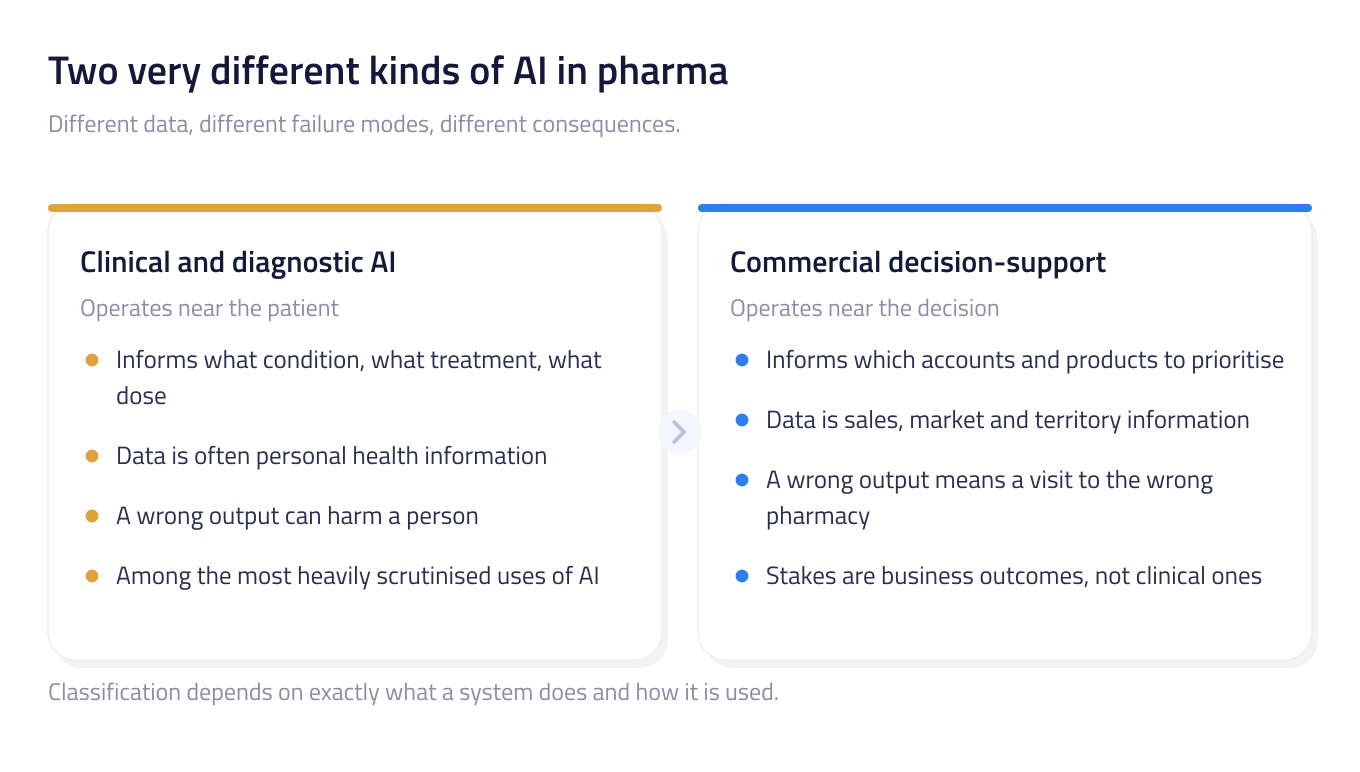
At one end sits clinical and diagnostic AI: systems that inform what condition a patient has, what treatment they should receive, or how a therapy should be dosed. The stakes are direct and physical. The data is often personal health information. A wrong output can harm a person. This is, rightly, among the most heavily scrutinised uses of AI anywhere.
At the other end sits commercial decision-support: systems that help a sales representative decide which accounts to prioritise, which products are losing ground in a territory, or where commercial effort is best spent. The stakes are business outcomes, not clinical ones. The data is sales, market, and territory information — sensitive and valuable, but not a diagnosis. A wrong output means a representative visits the wrong pharmacy or leads with the wrong product, not that a patient is harmed.
These are not two points on a single scale. They are different activities, with different data, different failure modes, and different consequences. Treating them as the same category is a mistake in both directions.
Why the distinction matters for risk and regulation
Modern AI frameworks, including the EU's, take a risk-based approach: the more serious the potential harm, the heavier the obligations. That is a sensible design, and it depends entirely on placing a given system in the right risk category in the first place.
A tool that helps a representative prioritise their visits does not belong in the same risk class as one that informs a treatment decision. When the two are conflated — when every mention of "AI" triggers the level of caution appropriate to a clinical system — the effect is to block useful, low-risk tools under a weight of scrutiny designed for something else entirely. The organisation ends up applying its heaviest controls to its lowest-risk software, while the genuine effort goes into managing a fear that does not match the actual exposure. Getting the category right is not a way of dodging responsibility. It is the precondition for applying the right amount of it.
"Lower risk" is not "no responsibility"
Here is the part that is easy to get wrong in the other direction. A commercial tool being lower-risk than a clinical one does not mean it carries no obligations. The category distinction is a reason to apply proportionate controls — not an excuse to apply none.
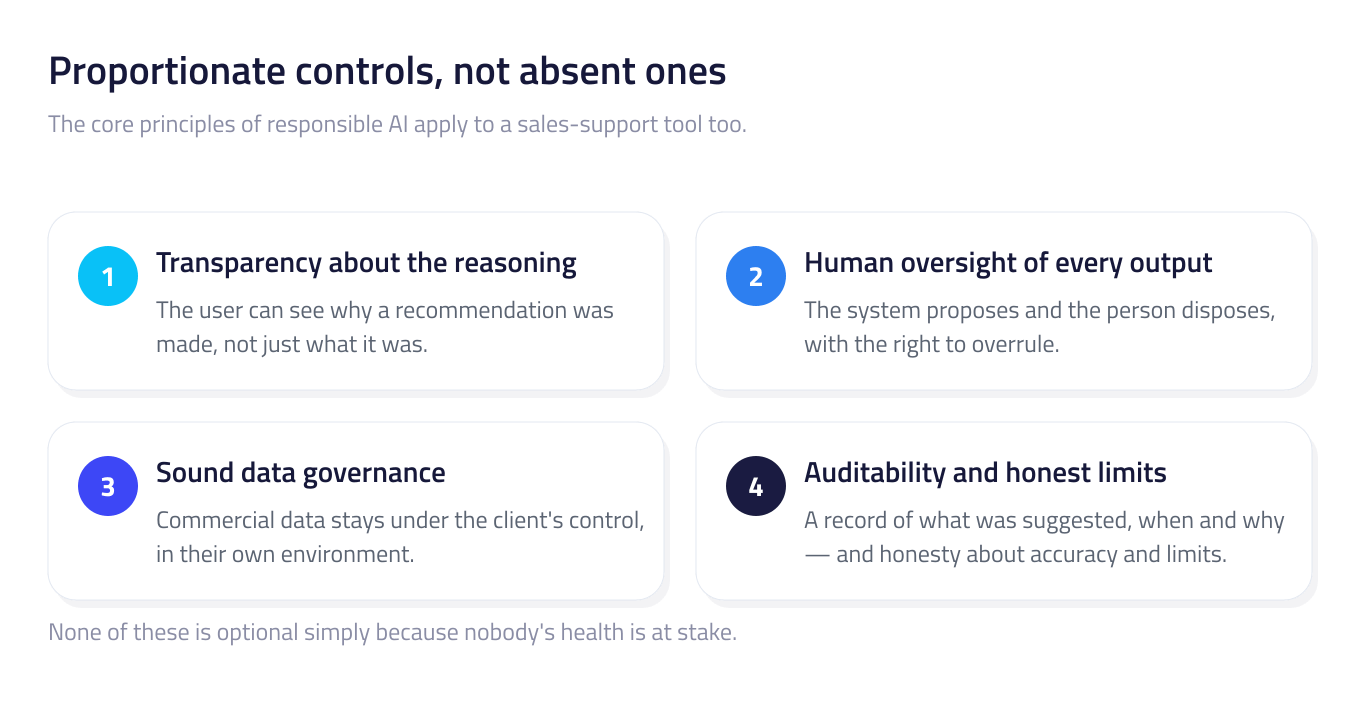
The core principles of responsible AI apply to a sales-support tool just as they apply anywhere: transparency about what the AI is doing, human oversight of its outputs, sound data governance, the ability to audit what was produced and why, and honesty about accuracy and limits. None of these is optional simply because nobody's health is at stake. A commercial tool that hides its reasoning, issues outputs no one checks, or is quietly wrong is irresponsible regardless of its risk tier. The right posture is proportionate, not absent.
What responsible AI actually looks like in a commercial tool
In practice, those principles are concrete, not abstract.
Transparency means the AI's output is identifiable as AI-generated and, more importantly, shows its reasoning — the user can see why a recommendation was made, not just what it was. Human oversight means the system proposes and the person disposes: recommendations are defaults to act on or overrule, never instructions that bypass judgement. Data governance means the commercial data stays under the client's control, within their own environment, governed by their existing security — the tool does not quietly become a new place sensitive data accumulates. Auditability means there is a record: what was suggested, when, and on what basis, so the organisation can trace a decision back if it ever needs to. And accuracy means being honest about confidence and limits, rather than dressing every output in the same decisive tone whether the data behind it is strong or thin.
Each of these is achievable in a commercial tool without the apparatus of a clinical system — which is exactly the point of getting the category right. Proportionate controls, properly implemented, rather than either over-engineering or neglect.
The compliance narrative as an enterprise asset
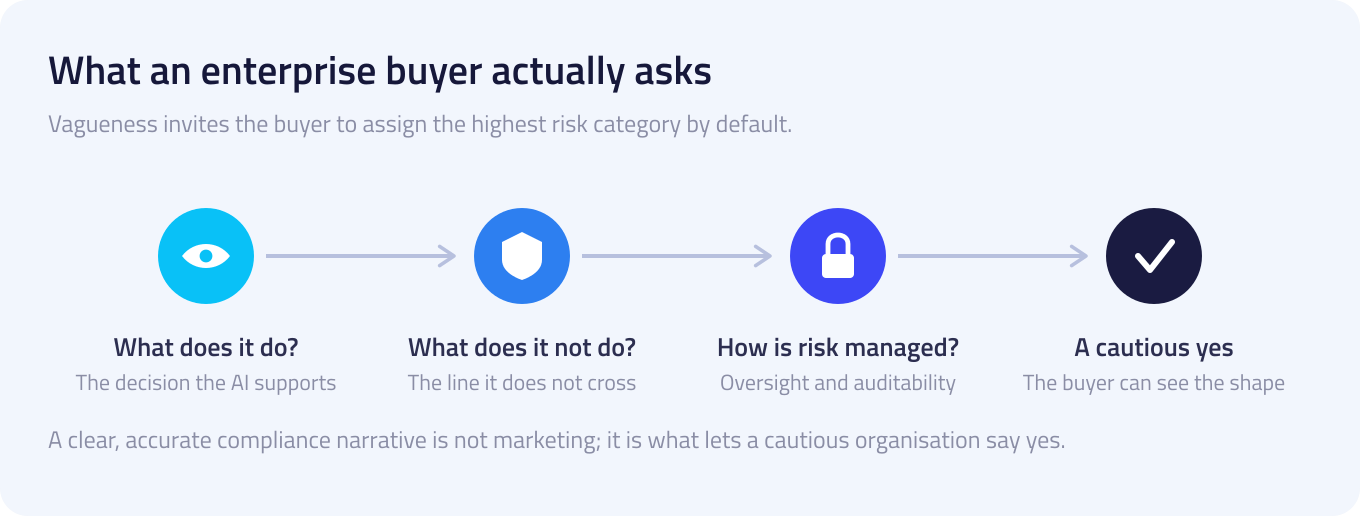
There is a commercial payoff to handling all this well, and it mirrors the way good data governance shortens a sale. An enterprise buyer's hardest questions about AI are not really about features. They are: what does this thing do, what does it not do, and how is the risk managed?
A vendor that can answer those three questions clearly and honestly — here is the decision the AI supports, here is the line it does not cross, here is how oversight and auditability work — turns a fraught conversation into a manageable one. Vagueness does the opposite: it invites the buyer to imagine the worst and assign the highest risk category by default. A clear, accurate compliance narrative is not marketing. It is the artefact that lets a cautious organisation say yes, because it can finally see the shape of what it is agreeing to.
The line you do not cross
All of which rests on actually staying on the right side of the boundary. Commercial intelligence informs business decisions about where to focus selling effort. It should not drift into clinical territory — making or implying claims about treatment, inferring things about individual patients, or producing anything intended to influence a medical decision. The moment a "commercial" tool starts doing that, it has changed category, and the lighter-touch framing no longer applies.
Knowing where that line sits, and designing deliberately to stay well clear of it, is itself part of responsible AI. The discipline is not just in what the tool does, but in being clear and consistent about what it refuses to do.
Conclusion
Responsible AI in commercial pharma is not about treating a sales-support tool as though it were a diagnostic device. It is about placing it in the right category, applying the controls that category genuinely warrants, and being honest and specific about the boundary it operates within. Fear and vagueness are not substitutes for that work — they are what fill the space when the work has not been done.
Pharmalyze.AI is positioned squarely as commercial decision-support: it helps commercial teams decide where to focus, not what to prescribe. Its outputs are recommendations a person reviews and can overrule, with their reasoning visible; the underlying data stays within the client's own environment; and it is built to be auditable and clear about its limits. The aim is a tool an enterprise can adopt with a straight answer to the three questions that matter — what it does, what it does not do, and how the risk is managed — rather than one that asks to be trusted on faith.