Home›Blog›The Real Cost of Visit Preparation
The Real Cost of Visit Preparation
By Vladimir Simeonov
Preparing for a visit is necessary work. But in most pharma field forces it has quietly become one of the largest uncosted line items on the commercial budget — and the easiest one to recover.
Every sales organisation tracks the things it pays for directly: salaries, cars, samples, congresses, CRM licences. Almost none of them track the thing that consumes a large share of a representative's day and appears on no budget line at all — the time spent preparing for visits.
It is easy to overlook because it doesn't look like a cost. It looks like diligence. A good representative checks the numbers before walking in, reviews what happened last time, and works out what to focus on. That is exactly what they should be doing. The problem is not the preparation itself. It is how long it takes, how often it gets squeezed, and how invisible the whole thing is to the people setting commercial strategy.
A cost nobody books
Preparation time is real work that produces no record. When a representative spends twenty minutes before a visit pulling sales figures from one system, last-visit notes from another, and targets from a third, that time is gone. It doesn't show up in CRM as activity. It isn't billed anywhere. It simply disappears into the gap between visits.
Because it is invisible, it never gets managed. A company that would scrutinise a five-figure increase in congress spend has usually never put a number on the hours its field force spends assembling context by hand. And what isn't measured doesn't get improved.
Let us do the arithmetic
The figures below are illustrative — a model, not a benchmark. The point is the method, not the exact numbers. Substitute your own and the conclusion rarely changes much.
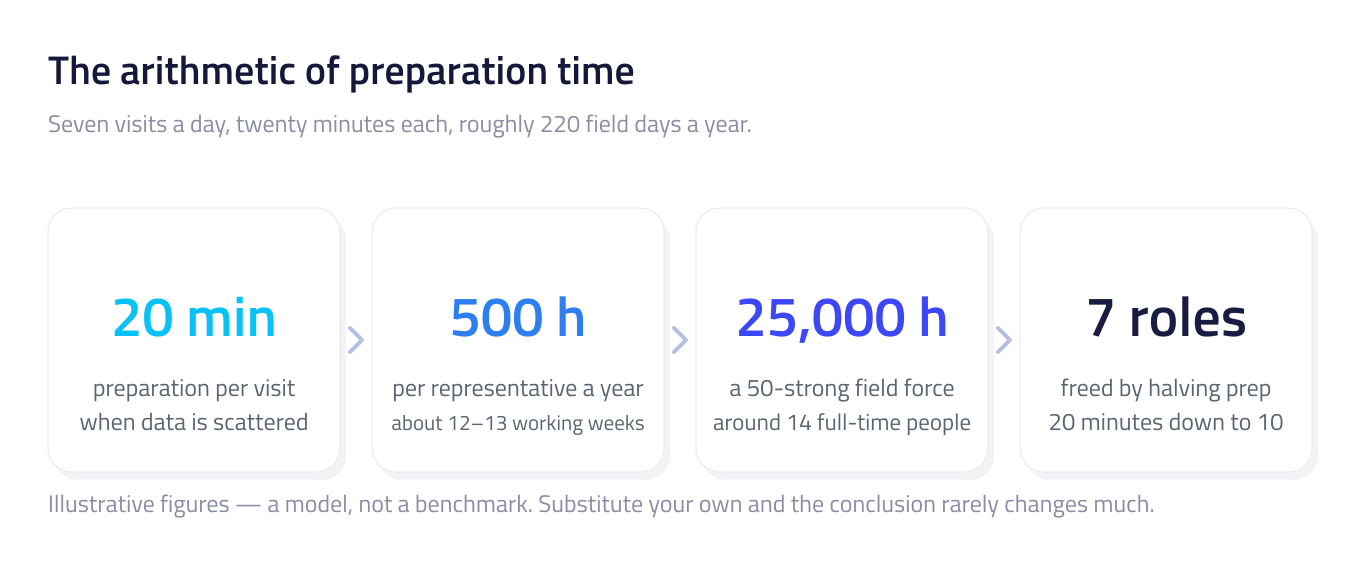
Take a representative who makes around seven meetings on a working day. Assume that doing preparation properly — checking the sales trend for that account, where market share sits against target, what was discussed last time, and what has changed since — takes roughly twenty minutes per visit when the data is scattered across several systems.
Seven visits at twenty minutes is about 140 minutes a day, or just over two hours. Across a working year of roughly 220 field days, that is close to 500 hours per representative — the equivalent of around twelve to thirteen full working weeks spent on preparation alone.
Now scale it. A field force of fifty representatives, on the same assumptions, spends in the order of 25,000 hours a year preparing for visits. That is equivalent to roughly fourteen full-time people doing nothing else, all year, but assembling context.
Halve the per-visit time — from twenty minutes to ten — and you free up the equivalent of seven full-time roles' worth of capacity, without hiring a single person. None of these numbers are exotic. They follow directly from the time it takes to open three systems and reconcile them, repeated several times a day, every day.
The cost you don't see is the quality you lose
The hours are only half of it. The more revealing cost is what happens when the preparation time isn't available.
When the day runs long or the next appointment is across town, preparation is the first thing to get cut. The representative walks in working from memory, or from whatever they could glance at in the car park. The visit still happens, and it still gets logged as activity — but it is a weaker visit. The opportunity that the data would have flagged goes unmentioned. The product that was quietly declining in that pharmacy doesn't come up. The account that needed attention gets a routine call instead.
This is the part that never appears in any cost model: not the time spent preparing, but the value lost on the visits where there wasn't time to prepare. A field force that is too busy to prepare well is, in effect, paying full price for half-prepared visits.
Why the time gets spent in the first place
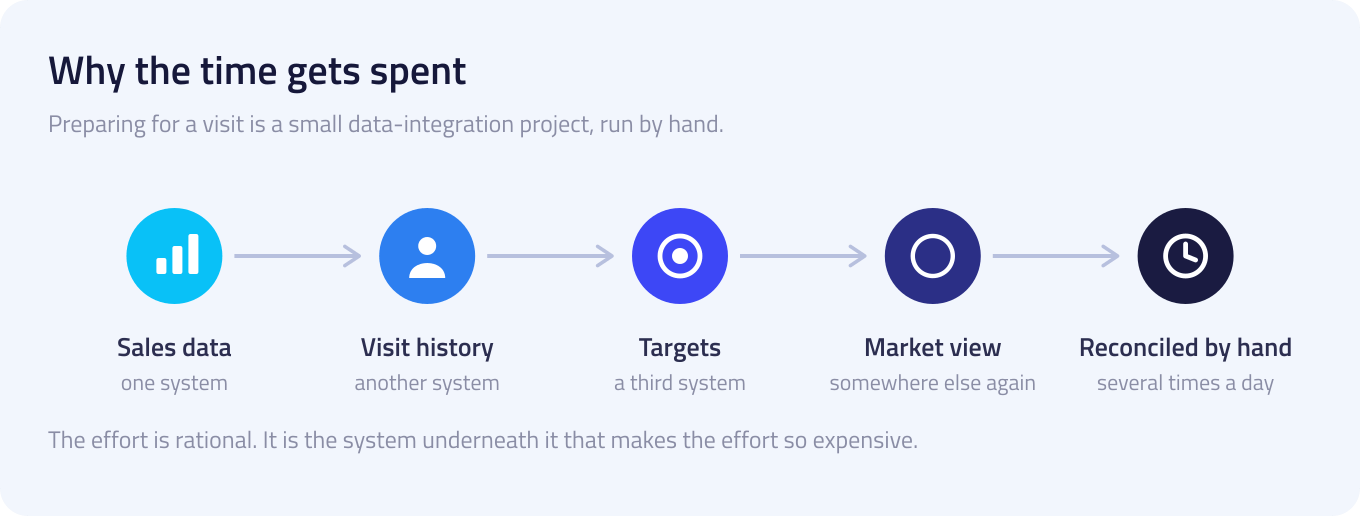
None of this is a failure of effort. Representatives spend the time because the information genuinely is hard to assemble. The sales data lives in one place, the visit history in another, the targets in a third, and the market view somewhere else again — each owned by a different team, each updated on its own schedule, none of them designed to answer a single practical question quickly.
So preparing for a visit becomes a small data-integration project that the representative runs by hand, several times a day. The effort is rational. It is the system underneath it that makes the effort so expensive.
What recovering the time is actually worth
It is worth being precise about the goal here, because the obvious conclusion is the wrong one. The point of cutting preparation time is not to cut the field force. It is to let the same field force do more, and do it better.
Recovered preparation time converts into three things commercial leaders already want. More capacity, because hours spent assembling data become hours available for customers or additional visits. Sharper targeting, because when context is instant, representatives prepare for every visit properly rather than only the ones they had time for. And more consistent execution, because performance stops depending on which representatives happen to be the most diligent at building their own data picture.
That last point matters most at scale. When preparation is hard, the quality of it varies enormously across a team. When it is fast and built in, the floor rises for everyone.
The goal is not zero preparation — it is preparation that pays
To be clear, the aim is not to remove preparation from the job. Walking into a visit with no context is worse than walking in with a little. Context is what makes a visit count.
The aim is to collapse the cost of getting that context — from twenty minutes of manual assembly to a couple of minutes of reading something already assembled. The representative still decides what to do with the information; they simply stop spending the better part of an hour a day producing it themselves. The judgement stays human. The data-wrangling does not need to be.
Conclusion
Visit preparation is one of the largest costs in a pharma field force and one of the least examined, precisely because it hides inside everyone's working day as ordinary diligence. Put a number on it and the scale becomes hard to ignore — and so does the opportunity, because it is recoverable without cutting a single role.
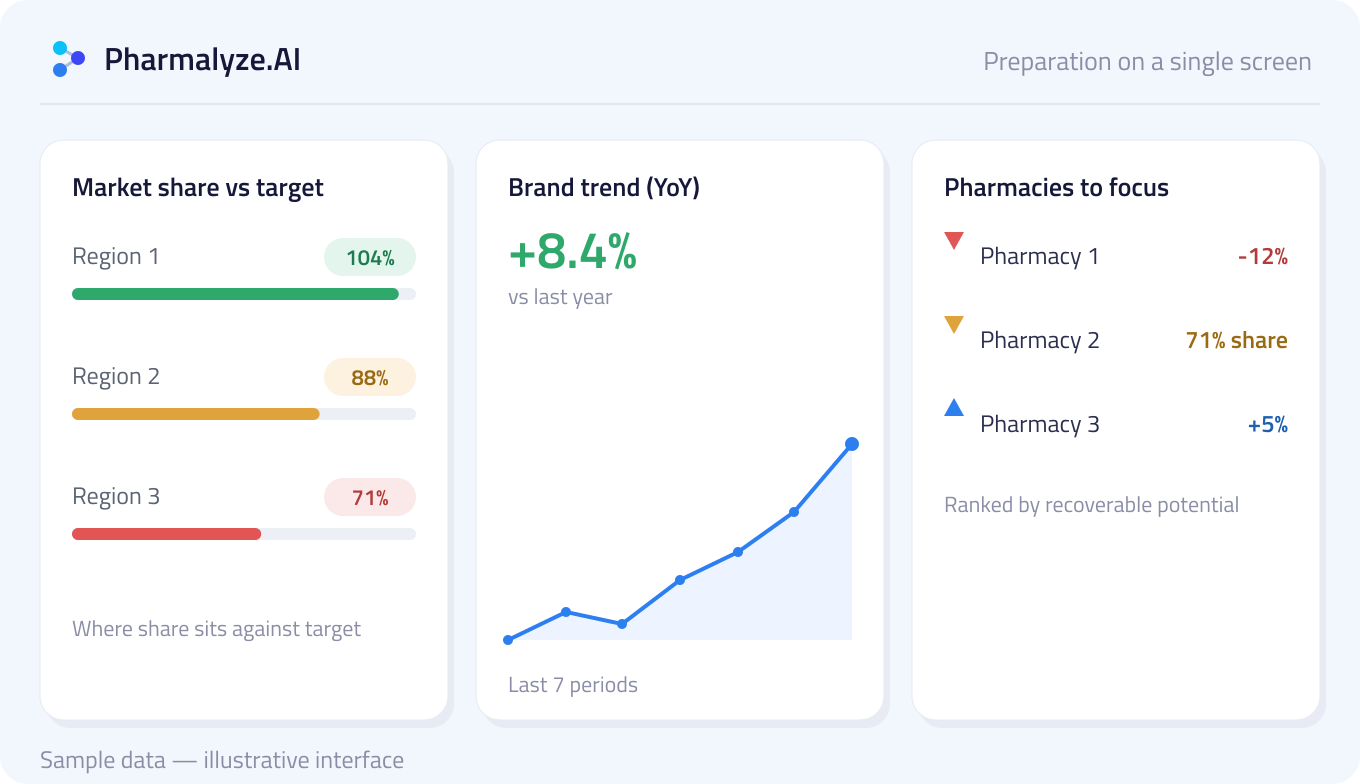
This is the practical case for commercial intelligence at the field level. Pharmalyze.AI takes the scattered data a representative would otherwise spend twenty minutes assembling — sales trend, market share against target, visit history, what changed since last time — and brings it together on a single mobile-first screen, so preparation takes minutes instead of the better part of an hour. The time doesn't vanish from the budget; it moves back to where it creates value — in front of the customer.