Home›Blog›Why HQ Targets Don't Survive the Territory
Why HQ Targets Don't Survive the Territory
By Vladimir Simeonov
A commercial plan only works if it reaches the pharmacy counter intact. Most of the time it doesn't — and the reason is rarely poor execution.
Every planning cycle, headquarters builds a commercial plan. Brand priorities, market-share targets, account segmentation, call expectations, the lot. On paper it is coherent: the growth brands are identified, the targets add up, the strategy is sound. Then it meets the territory, and something gets lost between the plan as written and the plan as lived.
The usual explanation is an execution problem — the field didn't follow through. Sometimes that is true. But far more often the plan degrades for reasons that have nothing to do with effort or discipline. It is a translation problem and a visibility problem, and both are fixable.
The plan is set where the data is, not where the selling happens
Headquarters has the aggregate view: national market share, portfolio strategy, where the company wants to grow and where it is willing to defend. That is the right altitude for strategy. You cannot set portfolio priorities from inside a single pharmacy.
But a national target is an average, and no territory is the average. The account mix is different. Competitive intensity is different. Local prescribing patterns, stock dynamics, and chain relationships are different. The same three-point share target means one kind of work in a strong territory and a completely different kind in a contested one. The plan sets the number; it rarely specifies what the number actually requires on the ground in each place. That translation is left to be worked out later — and mostly, it isn't.
Every layer of translation loses something
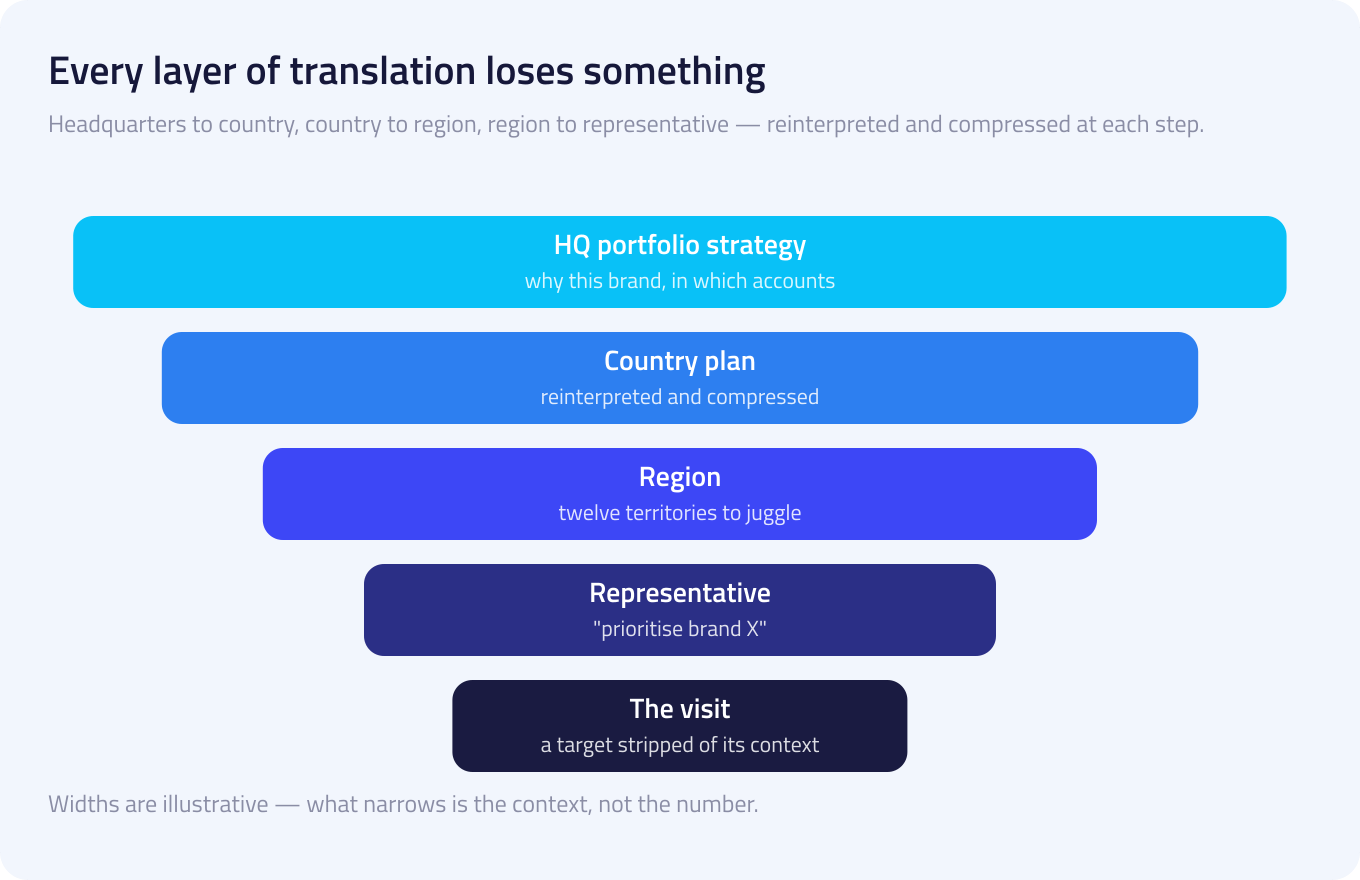
A central plan does not travel directly to a representative. It passes through layers — headquarters to country, country to region, region to representative — and at each step it is reinterpreted and compressed. A nuanced portfolio strategy becomes "prioritise brand X." "Prioritise brand X" becomes "hit your number on X." By the time it reaches the visit, much of the original reasoning — why this brand, in which accounts, against which competitor — has fallen away.
This is the children's game of telephone, played with commercial strategy. It happens not because anyone is careless, but because each layer keeps the part that is legible to it and drops the rest. A regional manager juggling twelve territories cannot carry the full strategic intent into each one; a representative with a full calendar cannot reconstruct it. What survives the journey is usually a target stripped of its context — which is the least useful part to arrive with.
A target a representative cannot see is a target they cannot hit
Then there is the feedback problem. In many organisations, a representative cannot tell whether they are on track against their target until the quarterly report arrives — by which point most of the quarter is already spent. They are driving toward a goal they can only check at the finish line.
A target without timely feedback is an instruction, not a steering signal. To actually change behaviour, a representative needs to know in week two that a territory is drifting, while there is still time to act, not to learn it in week twelve when the result is already fixed. Without that, even a perfectly translated target sits inert. The representative knows the destination but has no live sense of whether they are heading toward it.
So the representative does what they can see
Faced with a target that lacks local specifics and a result they cannot check until it is too late, representatives do the rational thing: they fall back on what they can see and what they know. The accounts where they have relationships. The products they understand best. The visits that fit the existing route. The pharmacy that is easy to reach rather than the one that matters most to the plan.
None of this is laziness. It is sensible local behaviour in the absence of a clear, current line of sight to the strategy. But it is local optimisation, not the company's strategy — and so the plan and the working day quietly drift apart. Headquarters believes the plan is running. The territory is running something else, assembled from habit and proximity.
Closing the gap: from a number to an action
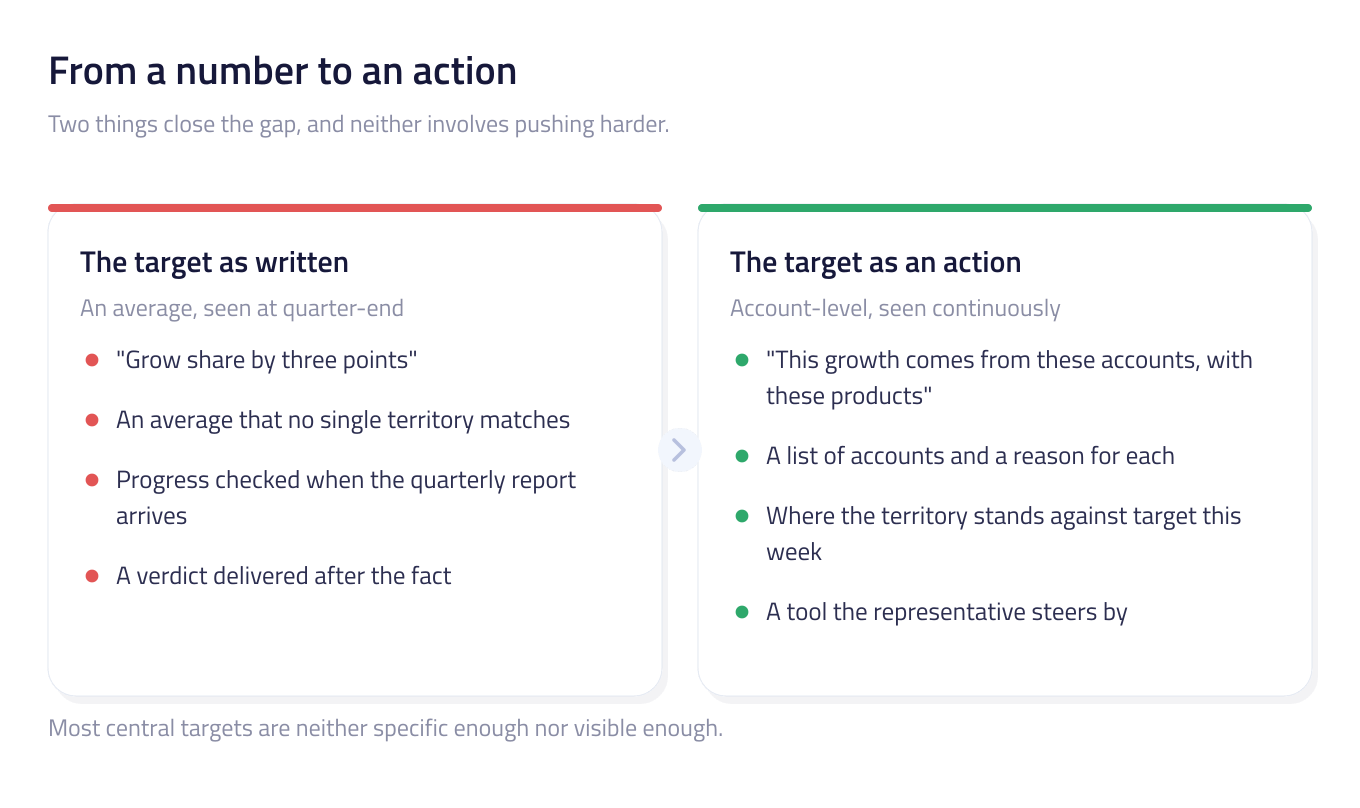
Two things close this gap, and neither involves pushing harder.
The first is translating the central target into territory-specific, account-level action. Not "grow share by three points," but "this growth comes from these accounts, with these products, in this territory." A representative cannot act on an average; they can act on a list of accounts and a reason for each. The strategy has to be carried all the way down to the level where the work actually happens, with its context intact.
The second is making progress visible continuously, not at quarter-end. When a representative can see where their territory stands against target this week, the target becomes a tool they steer by rather than a verdict delivered after the fact. A goal becomes hittable when it is both specific enough to act on and visible enough to correct against. Most central targets are neither.
And the plan should listen back
The flow cannot be one-way. Sometimes the territory does not reveal an execution failure — it reveals that the target was wrong. Built on assumptions that have aged, or a market that moved after the plan was set. If there is no path for field reality to travel back up, headquarters cannot tell the difference between a plan that is being executed badly and a plan that was never right for that territory in the first place.
A commercial plan that can hear back from the field stays honest. It lets leadership distinguish the territory that needs support from the target that needs revising — and that distinction is usually invisible from headquarters, where every shortfall looks the same on the dashboard.
Conclusion
The strategy-execution gap is almost always blamed on the field. More often it is a translation-and-feedback failure: a plan set at the right altitude that never gets converted into local action, and never made visible in time for anyone to steer by it. Close those two gaps and execution tends to follow — not because the field is working harder, but because the plan is finally legible where the selling happens.
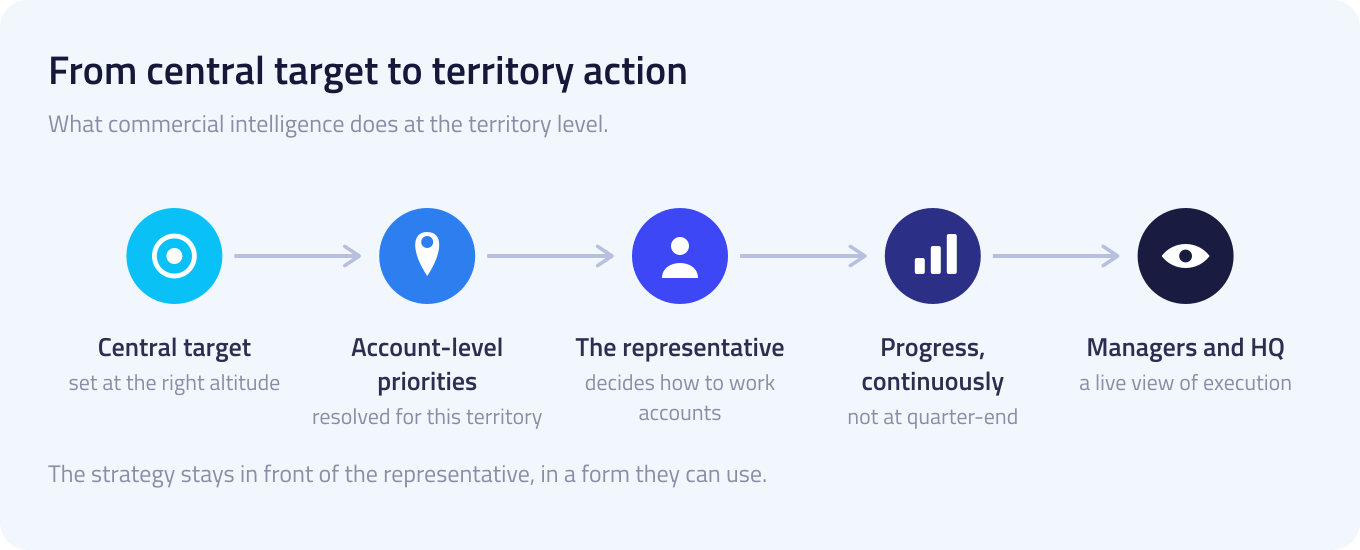
This is what commercial intelligence does at the territory level. Pharmalyze.AI takes a central target and resolves it into account-level priorities a representative can act on, shows progress against it continuously rather than at quarter-end, and gives managers and headquarters a live view of execution — so the plan and the territory stay aligned through the quarter, not just on the planning slide. The representative still decides how to work each account; the system simply keeps the strategy in front of them, in a form they can use.